



Favourites
Welcome to the Itinerary Planner. Use this tool to build your own journey or choose from an exciting range of specially selected tours.
To build your own Itinerary, click  to add an item to your Itinerary basket.



Welcome to the Itinerary Planner. Use this tool to build your own journey or choose from an exciting range of specially selected tours.
To build your own Itinerary, click to add an item to your Itinerary basket.

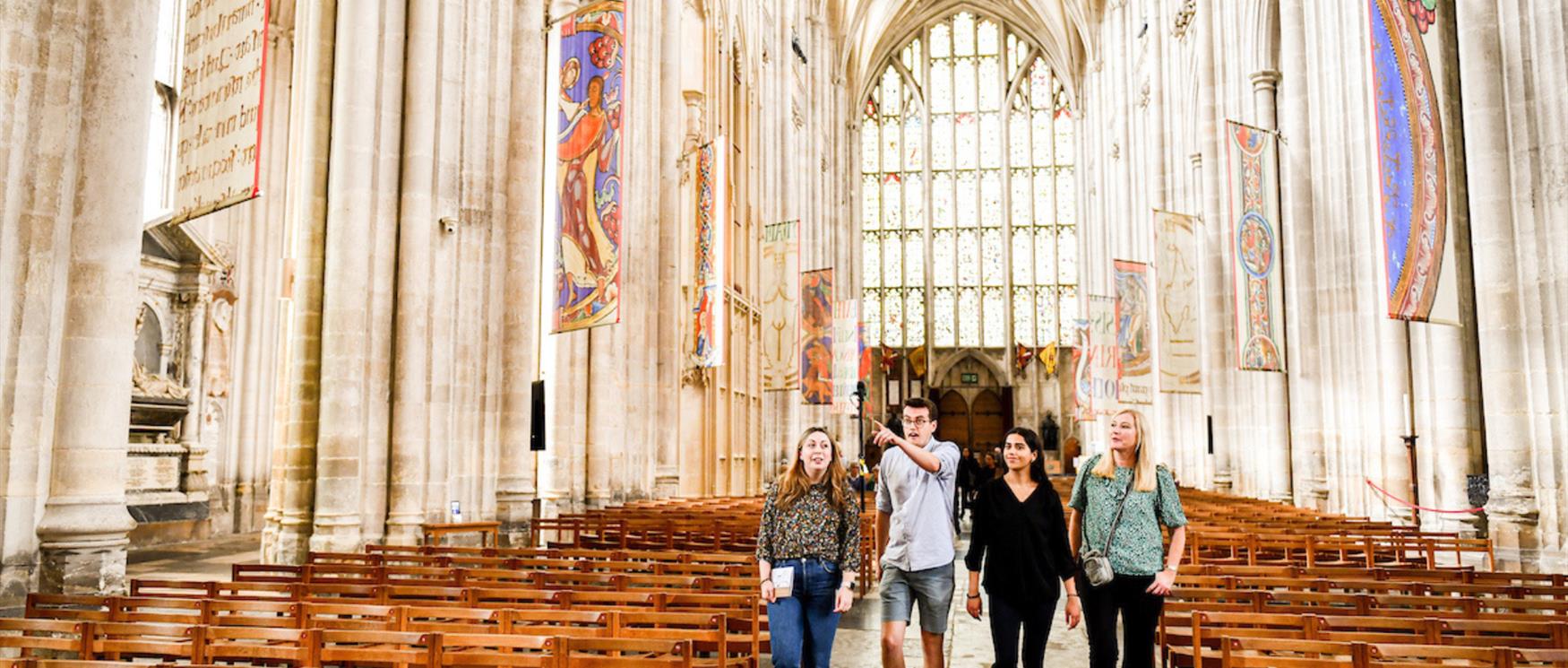
Hampshire sits at the very heart of the Norman story. When William, Duke of Normandy, crossed the Channel in 1066 and defeated King Harold at the Battle of Hastings, the county he turned to first was this one. Winchester was the ancient capital of England, and it was here that William established his authority, built his castle, and began reshaping an entire kingdom.
2027 marks the 1,000th anniversary of William the Conqueror’s birth, and the European Year of the Normans brings Hampshire’s Norman connections to the fore like never before. From Winchester Cathedral’s magnificent Romanesque nave to the ancient hunting grounds of the New Forest, the Conqueror’s mark on this county is still written in stone, in landscape, and in living tradition.
This page will be updated throughout 2027 as events, tours, and special experiences are added. Bookmark it and come back often.
In the early weeks of 1067, just days after his coronation in Westminster Abbey on Christmas Day 1066, William the Conqueror ordered the construction of a castle within Winchester’s Roman walls. For the next century, Winchester served as the centre of Anglo-Norman government and royal power, the place where the Domesday Book was commissioned and where the treasury was kept.
The most visible legacy of this extraordinary chapter is Winchester Cathedral, begun in 1079 on William’s orders. Its nave is the longest of any Gothic cathedral in Europe at 164 metres, and the Norman crypt beneath it is one of the most atmospheric spaces in the county. Whilst the building evolved across centuries, its Norman roots are unmistakable in the sheer scale of the structure and the solidity of its Romanesque bones. Inside, visitors can explore the Winchester Norman exhibition and discover how the city adapted and changed in the wake of the Conquest.
The only surviving part of William’s original castle is The Great Hall, rebuilt in the 13th century by Henry III and home to the legendary King Arthur’s Round Table. It’s free to visit and, standing inside it, the weight of a thousand years of history is hard to ignore.
Throughout 2027, join one of Winchester’s professional guides for a 90-minute walking tour starting at the Winchester Visitor Information Centre. The tour traces the city’s Norman and Saxon connections, including Queen Emma’s role in bringing Norman influence to Saxon England and Winchester’s celebrated embroidery tradition, the craft that created the most famous textile in European history.
Don’t miss: the Hospital of St Cross, founded by Henry of Blois, Bishop of Winchester and grandson of William the Conqueror, and believed to be England’s oldest charitable institution. Just a short walk from the cathedral, it remains a working almshouse to this day.
Discover more about Winchester
In 1079, William the Conqueror created the New Forest as his personal royal hunting ground, calling it Nova Foresta. He displaced local communities, enforced harsh Forest Laws to protect his ‘beasts of the chase’, and transformed this corner of Hampshire into a landscape that would remain largely unchanged for a millennium.
What’s extraordinary is that the ancient system William established to protect and manage the woodland and heathland is still in place today. The Verderers, Agisters and Commoners, the judges, stockmen and land users of the Forest, uphold a system that stretches back directly to 1079. The free-roaming ponies that wander the heathland are one of the most visible and beloved expressions of this living history.
The Forest also has a darker side to the Norman story. The English hated William and his harsh laws, and it was seen as divine justice when the New Forest claimed the lives of two of his sons and a grandson. William Rufus (William II) was killed by a stray arrow near what is now the Rufus Stone at Brook, a spot still marked and visited today.
Spend a day in the New Forest discovering its ancient landscape, its chocolate-box villages, and the thriving commoning tradition that William himself began. Beaulieu National Motor Museum also offers the chance to visit the ruins of Beaulieu Abbey, founded in 1204 by King John, a direct descendant of the Conqueror.
Explore the New Forest
Following 1066, William lost little time confiscating Anglo-Saxon church buildings and filling vacant clergy positions with French craftsmen and clergy who had crossed the Channel with him. What followed was a riotous period of church building, and Hampshire’s countryside is still dotted with the results.
The Norman Romanesque style brought wider, more decorated arches, blind arcades, great turrets and towers, and an artistic flair that can be seen in ever more elaborate stonework. Hampshire has some of the finest examples in England.
Romsey Abbey is one of the most magnificent Norman abbeys in the country, its interior a showcase of the ambition and skill of Norman masons working at the very top of their craft. St Peter’s Church in Petersfield offers a beautifully preserved example of the wider Norman arch style, while Portchester Castle on the coast combines one of the finest Norman castle keeps in the country with Roman walls that William’s engineers simply made their own.
Discover Hampshire’s historic churches and castles
For the first time in its thousand-year history, the Bayeux Tapestry will be displayed in the UK, at the British Museum in London from September 2026 to July 2027. Depicting the events leading up to the Battle of Hastings and the Conquest itself, it is one of the oldest and most extraordinary historical documents in Europe, made by English craftsmen on the orders of William’s half-brother, Bishop Odo.
Hampshire has a compelling connection to the Tapestry’s creation. The region was one of the great centres of embroidery excellence in Saxon and early Norman England, and the story of how Queen Edith and the craftswomen of Winchester may have contributed to the Tapestry’s making is one of the threads running through the 2027 Winchester Norman walking tours.
A visit to the Tapestry in London pairs brilliantly with time in Hampshire, tracing William’s invasion route from Pevensey and Hastings through to his ultimate power base at Winchester. The full story of the Conquest only makes sense when you see both ends of it.
Events and special experiences will be added to this page throughout 2027 as they are confirmed. Check back regularly for walking tours, exhibitions, symposiums, and special access events at Hampshire’s Norman sites.
Hampshire makes a brilliant base for exploring the full Norman trail. Stay in Winchester to be at the heart of the story, with easy day trips to the New Forest, Romsey Abbey and Portchester Castle. The county is well connected by rail and road, with London Waterloo just over an hour away.
Find places to stay in Winchester
Hampshire accommodation for groups
Hampshire has been at the heart of English history for a thousand years. In 2027, that history comes alive. Follow us on social media for Norman Hampshire moments all year, and explore our website further for the latest events, itineraries and inspiration.
No results found.
Copyright 2026 Visit Hampshire. All Rights Reserved


Take a look at the properties you can stay in that are managed by New Forest Cottages.
Beaulieu, Home of the National Motor Museum
Free Days Out in Hampshire